
← Program AssociatesJunior Fellow
Nikita Ivaniuta

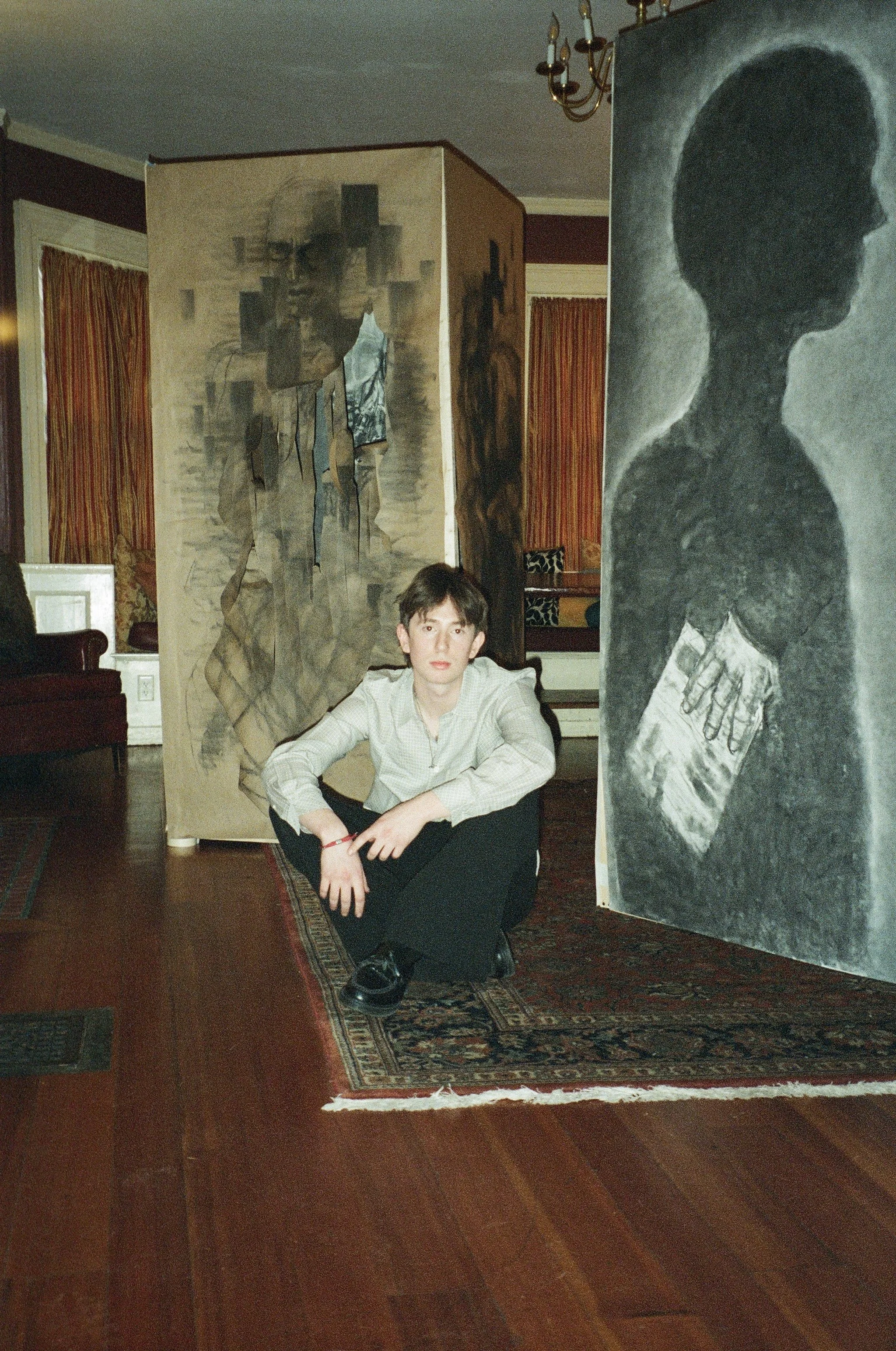
Nikita's work functions as a visual journal — a deeply personal record of experience and reflection rooted in the ongoing war in his home country of Ukraine. His paintings and drawings explore the psychological terrain of conflict: alienation, patriotism, nostalgia, survivor's guilt, and PTSD, seeking an intimate connection with anyone who encounters them.
Guided by J.M.W. Turner's conviction that painting and poetry mirror each other's beauty, Nikita physically integrates verse into his work as a foundational layer. Poems by Siegfried Sassoon and Rupert Brooke are embedded beneath the surface of pieces like Somehow and A Conversation, with key words quietly directing the viewer's eye and prompting reflection on ideas as charged and fragile as "peace."
His process owes a debt to André Masson's automatic drawing — the subconscious given free rein, rarely interrupted by preliminary sketching. Even at large scale, his work retains an immediate, sketch-like quality that mirrors his genuine emotional state. Intentional incompleteness and visible marks of process, in the spirit of William Kentridge, are not flaws but disclosures: an honest account of how a work came to be. Stylistically, Nikita draws from the Vienna Secession — the bold figuration of Egon Schiele and the raw post-war portraiture of Oskar Kokoschka.
Much of his work, by coincidence or something closer to necessity, has been made to the sound of rain — those same rhythms, he suggests, that surface memories of the moments that have shaped him.